Saturday, April 23, 2011

virtuoso


So I know I told you that I quit watching television and that's mostly true. That doesn't mean that it isn't on all the time or that someone else isn't watching it, usually in the other room.

Though I will admit that I watch soap operas during the day while I work. My interest in the story lines waxes and wanes but it's like having a very long book read to you with pictures. Mostly I just listen and look up every now and then.

This isn't about that even though two of the three soap operas I watch are finally being cancelled this year and not even Oprah can save them. Apparently she was prevailed upon to add them to her network. She replied (and I'm paraphrasing here), “Honey, those shows have been on for over 30 years. If there was still a penny to be made from them, somebody would already be making it.”

But I digress.

Friday, I got called from the other room.

“Hey Ellen, come look at this.”


'This' turned out to be a segment on the Today Show, an interview with 23 year old virtuoso, Hahn-Bin, a classical violin prodigy and protege of Itzhak Pearlman. It was so visually unexpected and his mastery so complete, he such a unique individual, that I had to look it up on the web and watch it again. And then I googled him to find out more.

I took the following from his website:


Born in Seoul, Hahn-Bin made his international debut at age twelve at the 42nd Grammy Awards performing in honor of Isaac Stern. Following a decade under the tutelage of Itzhak Perlman at The Juilliard School, Hahn-Bin made his critically-acclaimed debut in 2009 at Carnegie’s Zankel Hall as the recipient of the Peter Marino Concert Prize, following his First Prize win at the prestigious Young Concert Artists International Auditions.

And then on to youtube. Instead of my trying to describe this amazing individual, you must experience him for yourself.


This first clip is a little over 4 minutes, excerpts from a single performance I think.


This second clip is an interview with Hahn-Bin interspersed with his music, about 7 minutes.


The third clip is a bit longer, 13 minutes but a complete piece.


And this last one is very short, 1 ½ minutes and is an ad for his performance at MoMA. If you didn't watch any of the others, at least watch/listen to this one.


Friday, April 22, 2011

earth day


I've been busy this week and haven't been very active in blogland. It seems the only thing on my mind lately is work or the gardens and I imagine everyone is tired of hearing about both. Or maybe I'm tired of writing about both. Since I quit watching TV, more or less, I have even less exposure to the outside world and to other things that might set me off on a blog post. And I've followed so may blogs now that I just can't get to every one every day, write my own and still get any kind of work done.
I was going to do an Earth Day post since this planet is near and dear to my heart, but here it is, Earth Day, and I have written nothing. So I thought I would just re-post my little rant from last year only I couldn't figure out how to do it without removing it from it's original spot in the line up. So here is a link to it:


Instead of a new post about saving the only home we've got and our disposable mentality, I have a challenge for you, a plastic awareness challenge. You can do this one or two ways (or both).

Make a list of every plastic thing you touch in just one day, any day. You can pick the day.

This is my list so far today and all I've done is get dressed and sit here with my coffee:

  1. the frames of my reading glasses
  2. my pill caddy
  3. the filtered water container
  4. my computer/keyboard/mouse
  5. the handle of the coffee maker carafe
  6. the laminate that covers my cabinet doors and drawing table
  7. the floor tiles in kitchen and bath

This is the other challenge. Save all the plastic you would throw away for one week and then make a list of that. Don't include the plastic that you recycle (assuming, of course, that you do recycle), only the things that would go in the landfill.

I'm going to do both and will publish my results next Friday.

And remember...refuse, reuse, recycle!


Wednesday, April 20, 2011

printing on glass


About a year ago, Houston's first 'glass center' opened. What I mean by that is that there have always been personal stained glass studios or stained glass/fusing studios whose proprietors also taught classes and there are a few private glass blowing studios, one of which offers classes, although this is more of a 'warm' glass community since our climate does not really lend itself to having a furnace running year 'round.

We also have the Houston Center for Contemporary Craft that has an artist-in-residence program and offers workshops, but their kilns are not really suitable for glass and they really don't like how messy glass can be. Lamp workers they are OK with as it is fairly self contained but casting is a messy deal and they really didn't like that.

So when Bob Paterson opened Hot Glass Houston, a resource outlet for Bullseye glass, a company that specializes in facilitating artists using glass as a medium, he not only provided a local resource for the glass many of us use but he also brings in very accomplished guest artists to do workshops in an amazing array of techniques.

And so, this past Monday and Tuesday, I participated in a workshop on transferring imagery to glass in an effort to finally figure out how I want to make the 'pictures' for the memory box.

There are several ways this can be accomplished...fusible decals, emulsion stencils for sandblasting, painting with enamels. This particular workshop taught by Carrie Iverson is a technique she developed from classic printing techniques coming from a printing background as she does. She prints on paper, on fabric and other substrates and she got interested in glass.

In this workshop, we used a traditional lithography printing technique that had been modified slightly for glass. I did take my camera but I did not take a single picture because almost from the moment I picked up the brayer and rolled it in ink, my hands were covered with ink and gum. Basically what we did was this:

We mixed printer's oil-based ink with a waxy substance and used a roller, a 'brayer', to transfer the ink to a laser print that had been coated with a gum solution first. After enough ink had been transferred to the print (the ink only stuck to the black of the image on the paper), we picked up the paper and flipped it over onto a 6" x 6" piece of glass, ink side down, and burnished it transferring the ink from the paper to the glass. The next step was to sift glass powder onto the still wet ink. Then you fire it and the ink burns off and the glass powder fires in.

My first impression was that this might be the way I wanted to go but then I thought maybe the results wouldn't be crisp enough. The first day we did two pieces in the morning, each on a single layer of glass, one fired to tack fused (you can still feel the texture of the glass powder on the glass), the other to full fuse (feels completely smooth).

black powder tack fused on clear

black powder full fused on white

In the afternoon we did three pieces, each two layers thick and fired to full fuse. There's a whole lot in here about colors of ink, colors of frit, colors of glass, reactives, layering, tones, etc. that I'm not going to go into but here is the result of my first day. I worked with the images provided by the class.


On the way there on the second day, before I had seen these, I was pretty convinced this wasn't going to give me the look I wanted, not crisp enough, or maybe, since this is a reliquary for a memory, that would be better because memories fade, right?

I was pleasantly surprised by the results of the previous day.

That second day we did three more pieces 2 layers thick, all to full fuse. I still didn't have any images of my own to bring in, being as we were at the city house, but several others in the workshop did and they shared around.

I haven't seen my pieces from the second day, that will have to wait til the next time we are in Houston, I'm kind of curious about one of them though. I wondered how it would look on sandblasted, etched, glass so on one of my tiles I used the blast booth to sandblast one of the clear pieces and then 'printed' the image on the sandblasted surface and stacked it on another piece of clear. Might be an interesting technique for the architectural work.

Anyway, I'm intrigued enough to try some on my own.


Sunday, April 17, 2011

J is for...


J is for...journal, journey, joining, jukebox

J is for jukebox.

Growing up in the 50s and 60s, jukeboxes were everywhere. My parents even had friends who had one in their bay house. As kids we used to love begging our parents for quarters and taking turns picking out songs and as teenagers, we put plenty in, often loading it up with a queue. You don't see them much anymore, new technology and all that.

This is intended primarily as a visual journey but here's few facts lifted straight from wikipedia.com:


one of the first selective jukeboxes was introduced in 1927 by the Automated Musical Instrument Company, later known as AMI.

The term "jukebox" came into use in the United States around 1940, apparently derived from the familiar usage "juke joint” from the Gullah word "juke" or "joog" meaning disorderly, rowdy, or wicked.

Wallboxes were an important, and profitable, part of any jukebox installation. Serving as a remote control, they enabled patrons to select tunes from their table or booth.

Initially playing music recorded on wax cylinders, the shellac 78 rpm record dominated jukeboxes in the early part of the 20th century. The Seeburg Corporation introduced an all 45 rpm vinyl record jukebox in 1950 leading to the 45 rpm record becoming the dominant jukebox media for the last half of the 20th century.

Jukeboxes were most popular from the 1940s through the mid-1960s, particularly during the 1950s.

Styling progressed from the plain wooden boxes in the early thirties to beautiful light shows with marbleized plastic and color animation in the Wurlitzer 850 Peacock of 1941. But after the United States entered the war, metal and plastic were needed for the war effort. Jukeboxes were considered "nonessential", and none were produced until 1946.

Many consider the 1940s to be the "golden age" of jukebox styling.


All images off the web.


Saturday, April 16, 2011

so, moving right along...


Today was the local garden club plant show and sale. I'm an actual member now so instead of just showing up as I did in previous years, now I actually have to be there. I manned the membership table with another lady. I received my work assignment in the mail because I missed that meeting. oops, forgot

8 AM – 11 AM

8 AM – 11 AM?

Obviously, these people don't know me. I'm barely out of bed at 8 AM. I've had no coffee, no breakfast, barely been to the bathroom.

And, I don't own an alarm clock.

“Am I going to have to call you?” my sister asks.

No, no. I can do this.

And I can, do. It's just that my circadian rhythms normally run about 2 hours behind everyone else's.

I actually got there early so as to look over all the plants offered for sale and make my selections. I even got there before my sister.

I wasn't planning on entering anything in the show mainly because my attention has been elsewhere but also because the main thing I was going to enter I stupidly forgot it and left it outside during a night of temps in the 20s and it is now, as we say, muerte. But in the end I picked out two plants in pots and took them.

I got a ribbon.


desert rose
3rd place in the 'dry dish' category


The event happens at the Wharton County Museum (that's also where we have our meetings there in the 'meeting room'), which happens to be just down the road from our country house. Besides the plant show and sale there is also a silent auction of garden related things donated by members and businesses.

the plant sale on the lawn out front

the plant show on tables inside with the exhibits moved back/condensed

each table represents a different category I think there were 8 in all

got a question?


At the end, after even the half price last hour, whatever plants that were left were given to whoever was standing around that wanted them. So between what I bought and what I brought home, I am going to be busy tomorrow.


Friday, April 15, 2011

wrens and work


I've been quite busy the last week and a half, what with watching the wren family and keeping an eye on the cat and watering the yard daily. It is so dry here. I can't even remember the last time we had a good rain. We had a teasing rain earlier in the week. Barely got the driveway wet, much less the ground. It's not that it's not raining at all, I have seen good rain in the distance, moving around us, it's just not raining on us.

The wrens have stayed pretty close to the house, moving from large shrub to large shrub. They've been in the photinia in the little side yard outside the back door for the last two days. I can hear the baby chirping as I type and see the parents foraging.


I've been feeling pressure lately, something in my head telling me 'get it done, get it done'. Not the pressure of a looming deadline but more like the pressure wave that precedes a large moving mass. A feeling that I had better get these projects finished that have been lingering for so long.

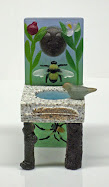
Mock Dogwood With Bee
6”wide x 2”high x 4”deep

To that end, I have been working on my various cast pieces. No more model making for a while. I got a piece finished (out of three that I started...didn't like the way one came out and the other needs something else) and sent off for the show at Kittrell/Riffkind gallery that opens the end of this month.


I also made two of the six models (working in clay) and molds to fulfill my end of the trade agreement with my (lesbian) ex-trainer. They are Venus pieces (mildly pornographic perhaps if you consider girl parts to be pornographic). Right now I have a test piece in the kiln for those pieces, trying out the way I thought to layer the glass in the mold.


And I've started assembling the wren box and the memory box (no more pictures of these two until they are completely finished). I have a glass stick for the top of the wren box but I really want it in bronze so I've got a call in to an art foundry. The memory box still needs me to finish grinding the excess glass off the top and make the photos that go in it. A little serendipitous (or syncronicitous) thing happened when I emailed the glass resource center in Houston where we teach asking about fusible photo transfer paper. Bob (the proprietor) offered me standing room only to observe the image transfer workshop that's being taught there on Monday and Tuesday of next week. The next day he emailed me that a student had dropped out and he offered me the spot. So Monday and Tuesday I'll be learning how to do the thing I need to finish the memory box.


Monday, April 11, 2011

I is for...


I is for...id, idiot, idol, idolatry

image via
http://www.makingthemodernworld.org.uk/learning_modules/psychology/02.TU.04/?section=11

I is for id

the part of the psyche, residing in the unconscious, that is the source of instinctive impulses that seek satisfaction in accordance with the pleasure principle and are modified by the ego and the superego before they are given overt expression.

As put forth by Sigmund Freud.

Personally, I don't care much for Freud. A typical male of the times, he considered women little more than grown children. I'd even go so far as to say he was a misogynist. One day a woman comes to him for help, probably someone who chaffed against the inequality, the inability to have an independent life, all the closed doors that women faced and said in a moment of total frustration, 'I wish I was a man'.

Thus was born, or so I imagine, the concept of 'penis envy', something that to me, as a woman, is a ridiculous idea. Really, Freud? That's the best you can do? Don't address the total dependence on some male for her entire life that was life for most women of the time.

Did she want to be a man, physically or did she just want the privileges and rights and opportunities accorded to even the stupidest and meanest man? I'm betting on the latter.

Anyway, it totally discredited him in my mind. I'm much more a Jung kinda person.

But, still, I kinda like the idea of the 'id'. That core of every human being, perhaps every living thing, that drives the pursuit of the essentials.

And what are these instinctive impulses that reside in our deepest selves, our prime directives as it were?

  1. the sustainment of life or self preservation.
  2. the promotion of life or curiosity, desire and happiness (if it feels good, do it).
  3. the continuance of life or, as we like to call it, sex.
Which is precisely why 'abstinence' will never work. Never ever.

Having sex is one of our prime directives. And we are horniest when we are most fertile.

Life does find a way.

Anyway, back to the id, when the 'id' sneaks out, slips past the ego and the superego, or burbles up from the 'collective unconscious', it's usually in a double entendre or a mis-placed word. A little reminder that just because we have already fulfilled our genetic duty, having passed on our genes to the next generation, it doesn't mean that that prime directive has gone away. It's still there, reminding us every now and then.

My recent status on FB:

'working on my friend's big flat lap all day. grind, grind, grind'